Our Work
Featured Projects
Explore some of our recent digital success stories.
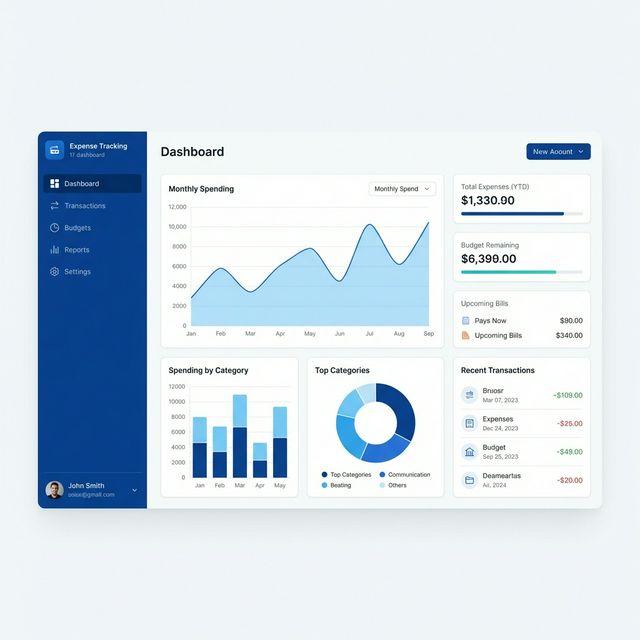
Serverless Expense Tracking
A revolutionary "Zero-Infrastructure" financial system built entirely on Google Workspace.

White-Label Digital Publishing
A military-grade DRM distribution platform handling millions of secured digital books.

Autonomous SEO Engine
An AI agent that monitors, repairs, and optimizes website rankings 24/7 without human intervention.

Self-Driving Ad Campaigns
A complete marketing loop: AI generates the creative, runs the ad, analyzes the data, and iterates.
The "Serverless" Miracle: Building on Google Drive
The Challenge
A mid-sized consultancy firm was drowning in operational costs. They needed a robust system to track complex expenses across 50+ remote groups and thousands of contractors. However, they were wary of traditional enterprise software: the licensing fees were exorbitant ($50k+/year), the learning curve was steep, and the maintenance required a dedicated IT team they didn't have. They asked us for a solution that was low-cost, zero-maintenance, and integrated with the tools they already used every day.
The Innovation
Digitorb proposed a radical architecture: What if we didn't build a backend at all?
We engineered a highly sophisticated application that uses Google Drive as its entire database and CMS. By leveraging the Google Workspace API and Google Apps Script, we turned the client's existing file storage - folders, Sheets, and Docs - into a structured relational database. The frontend was built as a Single Page Application (SPA) that communicates directly with these Google services.
Technical Implementation & Stack
- Database Layer: Google Sheets served as the relational tables, while Google Drive folders organized receipts and documents. We verified data integrity using custom validation scripts ensuring no "bad data" ever entered the Sheets.
- Zero Hosting Cost: The client pays $0 in server fees. The entire infrastructure runs on their existing Google Workspace subscription, leveraging the high availability and security of Google's global servers.
- Identity Management: We completely bypassed building a custom login system. The app uses "Sign in with Google." If a user leaves the company and their Google account is suspended, they instantly lose access to the app.
The "Group Tracking" Feature
The most complex requirement was "Group Tracking." The client needed expenses to be visible only to specific team leads. We implemented this by mapping app permissions to Drive Folder permissions. When an admin adds a user to a "Project Alpha" group in the app, the system silently shares the "Project Alpha" Drive folder with that user in the background. It is a seamless marriage of UI and file-system permissions.
The Outcome
The system now processes over $2M in expense tracking annually with 100% uptime. The client's operating cost for the software is arguably negative, as it utilized storage space they were already paying for. It stands as a testament to "Frugal Engineering" - solving expensive problems with smart, existing architecture rather than throwing money at new servers.
Fort Knox for Books: A White-Label DRM Platform
The Challenge
In the digital publishing world, piracy is the existential threat. A consortium of textbook publishers approached us with a dilemma: they wanted to distribute expensive medical and engineering textbooks digitally to universities, but they couldn't risk the files being leaked. Just one leaked PDF of a $400 textbook means millions in lost revenue. Existing solutions like Adobe Digital Editions were universally hated by students for being clunky, ugly, and hard to use.
The Innovation
We built a White-Label Reading Ecosystem that prioritizes both security and user experience. It isn't just an app; it is a secure content delivery pipeline that gives publishers total control over their assets while giving students a "Kindle-like" premium reading experience.
Security & Technology Stack
- Custom DRM Core (C++ & WASM): We engineered a proprietary encryption layer using AES-256 bits. Crucially, the decryption happens in-memory via WebAssembly on the browser or native C++ code on mobile. A decrypted file never touches the user's hard drive, making it impossible to "rip."
- Dynamic Watermarking: If a user takes a screenshot, our system invisibly embeds their User ID into the pixel data of the image. This "Social DRM" discourages sharing without hindering the reading experience.
- Cross-Platform Sync: The entire library state (current page, highlights, notes) is synchronized via WebSockets. A student can highlight a paragraph on their iPad on the bus, and that highlight appears instantly on their desktop web reader when they get home.
The Publisher Experience
For the publishers, we built a "God View" dashboard. They can upload an EPUB or PDF, click "Protect," and instantly generate unique license keys for universities. They also get granular analytics: seeing exactly which chapters are read most often, where students drop off, and even heatmaps of popular highlights.
The Outcome
The platform currently hosts over 50,000 titles and serves 20 universities. Piracy incidents for books on our platform dropped to near zero. More importantly, the reading experience is so smooth (fluid animations, sepia modes, smart search) that students actually prefer it to paper. We proved that security doesn't have to come at the cost of usability.
The 24/7 SEO Employee: Autonomous Optimization
The Challenge
SEO (Search Engine Optimization) is usually a manual, reactive, and painfully slow process. You wait for rankings to drop, then you panic, then you hire a consultant, then they write a report, and you wait 3 months for fixes. A high-volume e-commerce client with 10,000 products couldn't afford this lag time. They needed to react to Google's algorithm changes instantly, not quarterly.
The Innovation
We developed an Autonomous AI SEO Agent. This isn't a dashboard that gives suggestions; it is a system that has the keys to the website and takes action. It continuously crawls the client's site, comparing it against the top 10 competitors for every target keyword.
Three Pillars of Automation
- Content Repair (Self-Healing): Using Large Language Models (LLMs), the AI analyzes low-performing pages. If it notices a product page is ranking lower because it lacks information on "warranty returns" (which competitors have), it drafts a new paragraph, validates it against the brand's style guide, and publishes it automatically via the CMS API.
- Local SEO Dominance: For their 500 physical locations, keeping Google Maps updated was a nightmare. Our agent automatically posts local updates based on inventory data (e.g., "New stock of Winter Tires in our Chicago branch!") and responds to reviews within 5 minutes, boosting local relevance signals.
- Technical Watchdog: It monitors Core Web Vitals in real-time. If a content editor uploads a massive 10MB image that kills page speed, the AI detects it, compresses it to WebP format, and replaces it on the server without ever waking up a developer.
The Outcome
Within 6 months, the client's organic traffic increased by 240%. The "AI Employee" made over 4,000 small optimizations that no human team would have had the time to identify, let alone execute. It essentially gamified Google's algorithm, reacting to changes faster than any competitor could. The marketing team now focuses on high-level strategy, while the AI handles the infinite game of optimization.
The Self-Driving Ad Campaign
The Challenge
Marketing for multi-location franchises is a logistical nightmare. A fitness franchise with 200 gyms needed to run ads on Facebook, Instagram, LinkedIn, and TikTok. Each location needed unique ads: they had different street addresses, different operational hours, and different local offers (e.g., "Miami" needs sunny imagery, "Seattle" needs rain imagery). Doing this manually required a team of 15 marketers just to copy-paste data, resulting in generic, "one-size-fits-all" creative that performed poorly.
The Innovation
We built a Closed-Loop Generative Marketing System. It completely removed the human bottleneck from the ad buying process, functioning like a high-frequency trading bot but for advertisements.
How It Works: The "Create-Deploy-Learn" Loop
- Generation (Generative AI): The system uses a fine-tuned image model to create 50 variations of an ad for each of the 200 locations every week. It automatically overlays the correct local address and pricing. It even checks the local weather API - if it's raining in Seattle, the ad shows people exercising indoors.
- Deployment (API Automation): It utilizes the Marketing APIs of Meta (Facebook/Instagram) and LinkedIn to traffic these thousands of ads automatically, setting geo-fences with extreme precision (down to the zip code).
- Analysis & Iteration (The Brain): This is the secret sauce. The system watches the Return on Ad Spend (ROAS) every hour. If "Ad Variation A" (Blue background) is losing money, it kills it immediately. If "Ad Variation B" (Red background) is winning, it doubles the budget and instructs the AI to "Make more ads like B."
The Outcome
The system now manages over $500k in monthly ad spend with minimal human supervision. The cost per lead dropped by 65% because the AI is ruthless about cutting losing ads instantly - something human media buyers hesitate to do emotionally. The client's marketing team transformed from "spreadsheet managers" to "strategy directors," letting the AI handle the tactical execution of 10,000+ monthly ads.